— A Practical Insight Based on FATENG ELECTRIC VGK400 Switchgear
Introduction
As urban infrastructure expands, industrial facilities become denser, and renewable energy projects move closer to load centers, space constraints have become one of the biggest challenges in power distribution design. Traditional medium voltage (MV) switchgear, while robust and reliable, often requires large installation areas, making it less suitable for modern compact substations, data centers, and modular power systems.
This has driven the rapid development of compact medium voltage switchgear, which must deliver the same—or higher—levels of safety, reliability, and performance within a significantly reduced footprint.
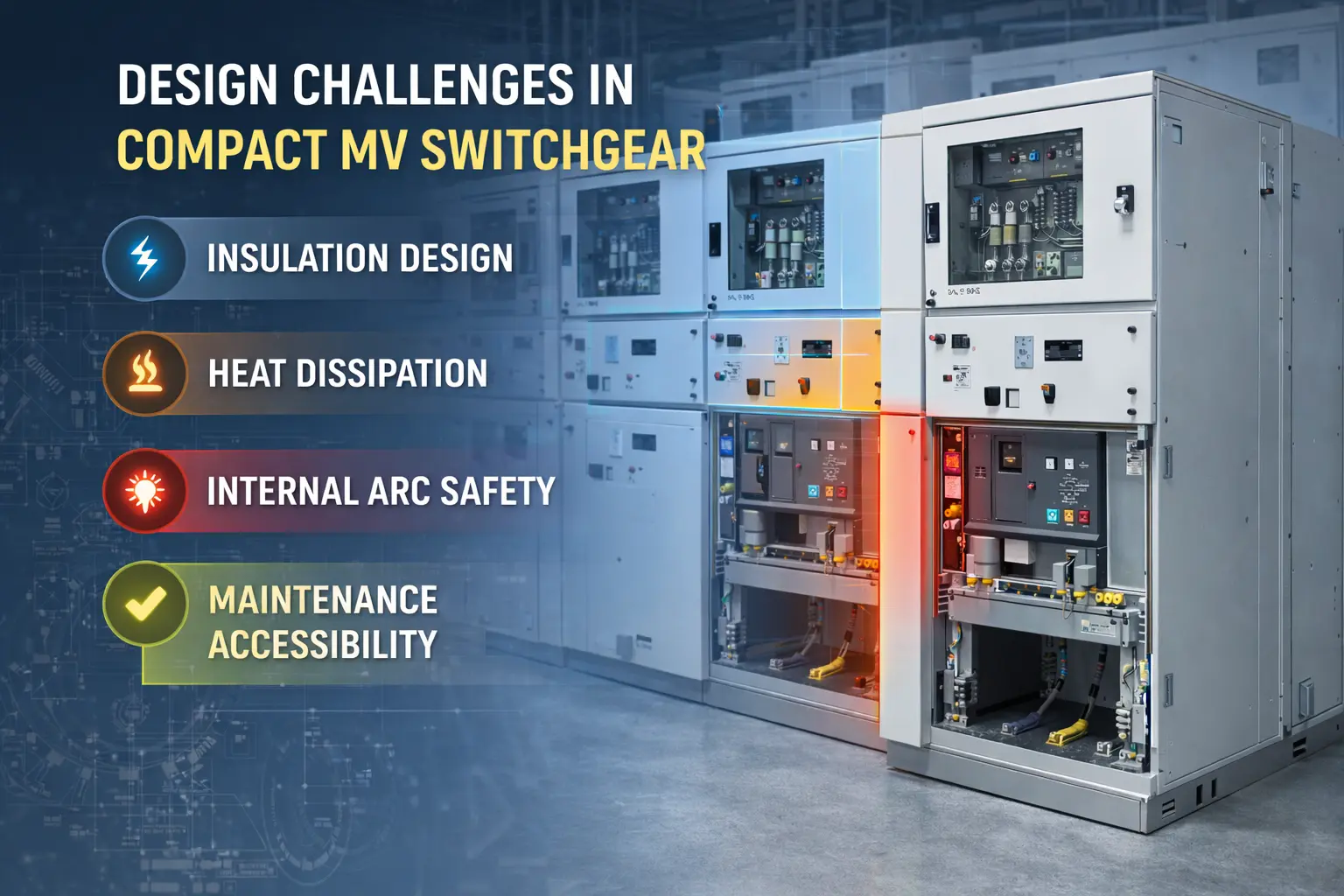
However, compact design introduces a series of technical and engineering challenges, including insulation coordination, thermal management, mechanical strength, and maintenance accessibility.
This article explores the key design challenges of compact MV switchgear and explains how FATENG ELECTRIC’s VGK400 metal-clad switchgear addresses these challenges through thoughtful engineering and proven solutions.
1. Why Compact Medium Voltage Switchgear Matters
Compact MV switchgear is no longer a niche product—it is becoming a standard requirement in many applications:
-
Urban substations with limited floor space
-
Industrial plants with high equipment density
-
Data centers and critical infrastructure
-
Renewable energy projects (wind, solar, BESS)
-
Modular substations and E-house solutions
Compared with conventional designs, compact switchgear offers:
-
Reduced building and civil costs
-
Faster installation and commissioning
-
Better suitability for prefabricated solutions
-
Improved flexibility for system expansion
However, shrinking physical dimensions without compromising performance is easier said than done.
2. Key Design Challenges for Compact MV Switchgear
2.1 Insulation and Dielectric Strength
One of the most critical challenges in compact switchgear design is maintaining adequate insulation distances.
As phase-to-phase and phase-to-ground clearances are reduced:
-
Electric field intensity increases
-
Risk of partial discharge rises
-
Insulation aging accelerates
Traditional air-insulated designs may struggle to meet IEC dielectric requirements when dimensions are aggressively reduced.
Design Challenge:
How to ensure reliable insulation performance in a confined space over the entire service life.
2.2 Thermal Management and Heat Dissipation
Compact switchgear concentrates components such as:
-
Vacuum circuit breakers
-
Busbars
-
Current transformers
-
Protection relays
This concentration leads to higher heat density, especially under:
-
High current operation
-
Continuous load conditions
-
Elevated ambient temperatures
Poor thermal design can result in:
-
Overheating of conductors
-
Reduced component lifespan
-
Nuisance trips or derating
Design Challenge:
How to manage heat effectively without increasing cabinet size.
2.3 Mechanical Strength and Internal Arc Safety
Reducing enclosure size does not reduce the energy of an internal arc fault.
In compact MV switchgear:
-
Pressure rise during arc faults is more intense
-
Structural deformation risks increase
-
Operator safety requirements remain stringent
Design Challenge:
How to maintain high internal arc classification while using lighter, more compact structures.
2.4 Maintenance Accessibility
Compact designs often lead to:
-
Tighter internal layouts
-
Reduced working space for maintenance
-
More complex cable routing
If not properly designed, this can:
-
Increase maintenance time
-
Raise the risk of human error
-
Reduce system availability
Design Challenge:
How to balance compactness with ease of operation and maintenance.
2.5 Standardization and Customization Balance
Modern projects demand:
-
Compliance with IEC standards
-
Flexibility for different schemes
-
Compatibility with digital protection and automation
Compact switchgear must remain modular and configurable, even with reduced dimensions.
Design Challenge:
How to achieve compactness without sacrificing system flexibility.
3. Design Solutions in FATENG ELECTRIC VGK400 Switchgear
The VGK400 metal-clad medium voltage switchgear is designed specifically to address the challenges above while meeting international market requirements.
3.1 Optimized Insulation Design
VGK400 adopts a carefully optimized insulation system featuring:
-
Well-controlled air insulation clearances
-
Precision busbar arrangement to reduce electric field concentration
-
High-quality epoxy insulation components
-
Strict partial discharge control during manufacturing
Through simulation and type testing, VGK400 ensures:
-
Stable dielectric performance
-
Compliance with IEC 62271 standards
-
Long-term insulation reliability
This allows the switchgear to remain compact without compromising electrical safety.
3.2 Advanced Thermal Design
To manage heat effectively in a compact enclosure, VGK400 integrates:
-
Optimized busbar cross-sections to reduce resistive losses
-
Rational airflow paths for natural or forced ventilation
-
Strategic placement of heat-generating components
-
Temperature rise verification through type tests
As a result, VGK400 achieves:
-
Safe temperature rise margins
-
Stable performance under continuous operation
-
Improved component lifespan
This makes it suitable for high-load industrial and utility applications.
3.3 Robust Mechanical Structure and Arc Fault Protection
Despite its compact footprint, VGK400 features:
-
Reinforced metal-clad enclosure design
-
Reliable pressure relief paths
-
Secure compartmentalization for breaker, busbar, and cable sections
The design supports:
-
Internal arc fault containment
-
Enhanced operator safety
-
Compliance with relevant internal arc classifications
This ensures that compact size does not mean reduced protection.
3.4 User-Friendly Operation and Maintenance
VGK400 maintains clear operational logic through:
-
Withdrawable vacuum circuit breaker design
-
Clearly separated functional compartments
-
Logical interlocking mechanisms
-
Front-access operation for confined installations
These features help:
-
Simplify routine inspection
-
Reduce maintenance downtime
-
Improve operational safety
Compact does not mean complicated—and VGK400 reflects this philosophy.
3.5 Modular and Configurable Architecture
VGK400 is designed as a modular system, allowing:
-
Various primary schemes
-
Different protection relay options
-
Integration with SCADA and digital substations
-
Compatibility with E-house and prefabricated substations
This makes it adaptable to:
-
Utility substations
-
Industrial power distribution
-
Renewable energy projects
4. Typical Applications of VGK400 Compact MV Switchgear
Thanks to its compact and reliable design, VGK400 is widely applicable in:
-
Industrial plants with limited electrical room space
-
Urban distribution substations
-
Renewable energy power collection systems
-
Data centers and critical infrastructure
-
Modular substations and E-house solutions
Its balanced design makes it especially suitable for projects where space, safety, and reliability are equally important.
5. Compact Switchgear: Trends and Future Outlook
The future of medium voltage switchgear is moving toward:
-
More compact and modular designs
-
Higher integration with digital monitoring
-
Greater compatibility with prefabricated solutions
-
Improved lifecycle efficiency
Compact MV switchgear like VGK400 is well-positioned to support these trends by combining engineering practicality with modern power system requirements.
Conclusion
Designing compact medium voltage switchgear is not simply about reducing dimensions—it is about solving complex engineering challenges related to insulation, thermal performance, safety, and usability.
Through optimized insulation design, effective thermal management, robust mechanical structure, and user-friendly configuration, FATENG ELECTRIC’s VGK400 switchgear demonstrates how compact MV switchgear can meet modern power distribution demands without compromise.
For projects requiring reliable, space-saving, and future-ready MV solutions, compact switchgear is no longer an option—it is the direction forward.
CONTACT US!
Email: ethan@fatengelectric.com
Whatsapp: +86 18051690281